Bliain Naofa 2000 Holy Year
Holy Years or Jubilee Years reflect the Biblical Jubilees which occured every seven years when the land was left fallow and all debts were forgiven. The first Jubilee Year in the Church was in the year 1300 and have occured periodically since then.
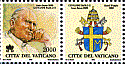
Pope John Paul II's
What is a Holy Year, this includes a fuller history.
We resume our chronicle with the Holy Year of 1750, celebrated by Benedict XIV. Indeed a special homage should be paid this Pope, who prepared the Jubilee with extraordinary care and piety, concentrating on its spiritual significance but mindful also of the necessary practical arrangements. A great number of pilgrims from all over the world made their way to Rome and their spiritual preparation was entrusted by the Pope to the most famous preachers of his time. In a highly significant ecumenic appeal Benedict XIV addressed also heretics and schismatics praying that the Holy Year be a year of reconciliation for all.
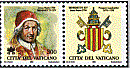
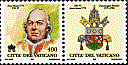
The Jubilee of 1775 was announced by Clement XIV but was opened, celebrated and closed by Pius VI. Illuminism was at its peak and the great European nations were ruled by "englightened despots", often at war with the Church. Perhaps because the climate was somewhat hostile to religion the number of pilgrims was lower than expected. Europe was on the eve of a period of dramatic struggles and upheavals that would climax into the French Revolution of 1789.
After the death of Pius VI, in exile in France, in 1799 Pius VII was elected Pope, but social and political troubles did not permit the celebration of the Jubilee of 1800. The next Holy Year was therefore held in 1825 by Pope Leo XII. Its historical context was one of full "restoration", following as it did the fall of Napoleon and the Congress of Vienna of 1815. It was a somewhat "sober" Jubilee: the Pope ruled that taverns and other public establishments were to be closed, reaffirming the obligation of fasting and chastity. He gave personal example of great devotion and humility: he visited the Churches barefooted several times, promoted processions, visited hospitals and charitable institutions. He also saw to the rapid reconstruction of the Basilica of St- Paul-outside-the-Walls that had been destroyed by a terrible fire in July 1823.
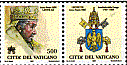
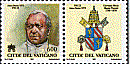
Pius IX, elected in 1846, could not celebrate the Holy Year of 1850 since the political events of 1848-49 had forced him to flee Rome: a popular rising had put an end to the temporal power of the Popes and the "Roman Republic" had been founded. Though the Roman Republic lasted only 138 days, the overall political and religious circumstances were not such as to permit the celebration of a Jubilee. Pius IX, whose pontificate was the longest in history (32 years) did, however, announce and celebrate the Holy Year of 1875. Rome had been for several years the capital of the Italian Kingdom, but the Pope had never accepted this new situation; the Holy Year was inaugurated with only the clergy in attendance and without the ritual opening of the Holy Doors. During this Jubilee the faithful came to Rome to pay homage to the Pope rather than on pilgrimage.
Leo XIII announced and celebrated the Holy Year of 1900 with renewed solemnity. The ninety year old Pontiff, author of 51 Encyclicals (including the famous Rerum Novarum on the condition of workers), though still considering himself a prisoner, took the first steps to end the Church's isolation and resume its magisterial role. In July of that year the assassination of the King of Italy Humbert I saw the Church sharing Italy's grief. The number of pilgrims was quite high, thanks also to a new means of transportation: trains.
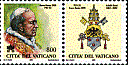
Pius XI announced the 1925 Jubilee with three goals:
world peace, Christian unity and a solution for the Holy Land. It was the first Holy Year after the grievous wounds of the First World War; it was also the first Holy Year that saw the arrival by plane of pilgrims from far away countries.
The next Holy Year was also held a few years after the end of a terrible war: World War II. Pius XII asked governments to show clemency and many countries granted pardons and amnesties. Popular participation was widespread as people looked forward to a new era of peace and prosperity. The Pope insistently reminded the faithful of the many people still suffering from poverty and from lack of religious and political freedom. The climax of the 1950 Jubilee was the proclamation of the Dogma of the Assumption of the Virgin Mary to Heaven. At its closing Pius XII announced the discovery of the Tomb of Peter, right beneath Michelangelo's dome.
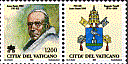
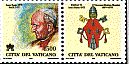
We thus arrive to the Jubilee of 1975, celebrated by Paul VI in the name of renewal and reconciliation. In the wake of Vatican Council II, Paul II celebrated an ecumenically inspired Holy Year, of great religious, cultural, spiritual and moral significance. Almost 10 million pilgrims visited the Eternal City, even though it was the first Holy Year in the era of TV. There were many meaningful meetings, for the Church and for the world at large. The Pope showed great humility in kissing the foot of the Metropolitan of Constantinoples.
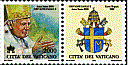
And so we have reached the Holy Year of 2000, whose history we are about to write, guided by His Holiness John Paul II.
Here is the official record!
Back to page One
Back to page two
Back to main Jubilee 2000 Page
Back to some Uplifting Pages
Back to Stamp Collectors Page
Back to The Instrumentation Signpost