 Jubileum 2000
Bliain Naofa 2000 Holy Year
Holy Years or Jubilee Years reflect the Biblical Jubilees which occured every seven years when the land was left fallow and all debts were forgiven. The first Jubilee Year in the Church was in the year 1300 and have occured periodically since then.
Pope John Paul II's Prayer for the Holy Year.
What is a Holy Year, this includes a fuller history.
Our historical journey through the long succession of Holy Years and the Popes who celebrated them reaches its second stage: the second issue covers the period between 1550 and 1725.
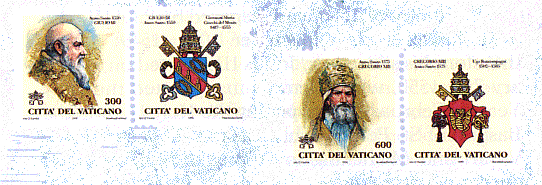 The Jubilee of 1550 was prepared by Paul III who died, however, on November 10th, 1549; it was therefore his suceessor, Julius III, elected on February 7th, 1550, who solemnly inaugurated the Holy Year on February 24th opening the Holy Door in the Basilica of St. Peter's. This was the Jubilee that saw Vasari and Michelangelo among the pilgrims and during which two great figures of the Church - St. Philip Neri and St. Ignatius of Loyola - were in Rome.
- Pope Gregory XIII celebrated in 1575 the first Holy Year after the closing of the Council of Trent (1563) which had profoundly reformed the Church. In the presence af St. Charles Borromeo, Archbishop of Milan, the elderly Pope opened the Holy Door of a Jubilee that saw the arrival of over 400.000 pilgrims and the meaningful participation of the Confraternities, both religious and lay.
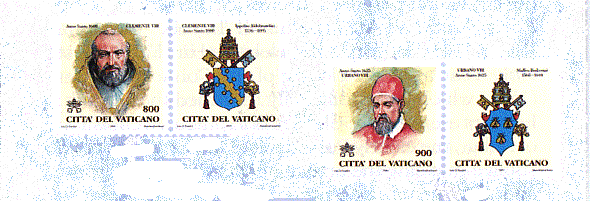 1600 was the Holy Year of Clement VIII who, despite his frail health, gave the example completing the penitential visits of the Basilicas sixty times. Over three million pilgrims, many of them from France and Germany, made their way to Rome.
- Urban VIII celebrated the following Jubilee (1625), saddened by the looming dangers of the Thirty Year war (1618-1648) and the epidemics that ravaged Rome. For fear of spreading the plague the Basilica of St-Paul-Outside-the-Walls was replaced with the Basilica of St. Mary in Trastevere. During this Jubilee the Pope extended the plenary indulgence to those who were physically unable to come to Rome (inmates, hermits, cloistered nuns, sick).
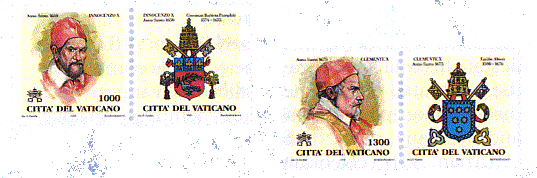 The Jubilee of 1650 was troubled by the feud within the Pamphili family, Pope Innocent X's family. Somehow peace was kept, though there were many fights and skirmishes between the French and Spanish contingents, whose countries were at war at that time. So many pilgrims flocked to Rome with the two great reigning families that it was necessary to reduce the number of visits to the four Basilicas.
- Pope Clement X celebrated the Holy Year of 1675. In front of a huge crowd the octogenarian Pope opened the Holy Door on Christmas Eve of 1674. Despite his advanced age Clement X made the tour of the Basilicas on foot five times; on Good Friday, after washing the feet of 12 pilgrims, he had dinner served to 13.000 people.
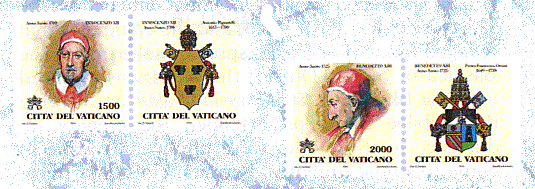 The Jubilee of 1700 was celebrated at the beginning of a century striving to "illuminate" European culture with the light of reason. It was a time of rapid changes, difficult years for the pontificate of Innocent XII, torn by theological and ecclesiological disputes. The jubilar celebratians of 1700 marked the first time that the Holy Door was opened by one Pope (Innocent XII) and closed by another (Clement XI). Innocent XII died in fact towards the end of 1700 and to further sadden an already troubled Jubilee the Tiber overflowed wreaking havoc in the city.
- The Holy Year of 1725 was celebrated by Benedict XIII, a Dominican. The sober simplicity of the jubilee ceremonies imposed by Benedict XIII was in sharp contrast to the pomp and splendor of the "Century of Light" and was resented by the Romans,whose pockets were consequently hurting. At the end of the Holy Year the pilgrims leaving Rome had been able to admire the splendid Spanish Steps, inaugurated during the celebrations.
|
Back to page one
To page three
Back to main Jubilee 2000 Page
Back to some Uplifting Pages
Back to Stamp Collectors Page
Back to The Instrumentation Signpost
Last changes on this page made 23/11/2003
|